Guggul: The Sacred Resin in Hindu Epics, Ayurveda, and Daily Ritual
By Akshita Singh | Sadhna.co Published: 2024 | Last Updated: 2026
Guggul (Commiphora wightii) is a resin that most people have smelled without knowing what it was. It's the base note underneath the smoke in a traditional havan, the deep earthy-balsamic quality that distinguishes a proper ritual fire from a decorative one. It has been in continuous ritual use in India for at least three thousand years — and unlike many things described as ancient, the archaeological and textual evidence for this is solid.
Understanding why Guggul has this kind of staying power requires looking at three things separately: what it does chemically, what the texts actually say about it, and how it fits into daily practice. Most Guggul blogs conflate all three into vague claims about "ancient healing." This one won't.
What Guggul Is
Guggul is an oleo-gum resin — a mix of essential oils, gum, and resin — extracted from the Commiphora wightii tree, a thorny shrub native to the dry regions of Rajasthan, Gujarat, and parts of Pakistan. The resin seeps naturally from the bark and is harvested by making incisions in the trunk, similar to the way frankincense is harvested from Boswellia trees in Arabia and East Africa.
The raw resin ranges from yellowish to dark brown depending on age and purity. When burned, it produces a distinctive smoke: earthy, slightly medicinal, with a balsamic depth that neither sandalwood nor camphor produces. This is the smell most North Indian households associate with havan — Guggul is the traditional havan resin, predating the commercially available havan samagri blends that now include it as one component among many.
Guggul is related to myrrh (Commiphora myrrha) — both belong to the same genus. The ritual use of both resins across completely separate cultures (Indian havan, Egyptian temple ritual, Christian liturgy) is one of those cross-civilisation parallels that suggests the specific combustion properties of Commiphora resins were discovered independently as useful for enclosed sacred spaces.
Guggul in the Ramayana: What the Text Actually Says
The Ramayana reference is genuine but is often exaggerated in retelling. Here is what Valmiki's Yuddha Kanda actually contains:
When Lakshmana is struck unconscious by Meghnad's Shakti weapon, Sushena (the physician among the Vanaras) lists the medicinal herbs needed for revival. The instruction to Hanuman involves several plants from the Gandhamadana mountain, and the combination of herbs — not any single one — is what revives Lakshmana. Guggul appears as part of the medicinal compound, not as the sole miraculous ingredient.
The significance of this is real, but it needs accurate framing: Guggul's presence in a Valmiki-authored text as a serious medicinal ingredient from approximately 500 BCE confirms its place in classical Indian pharmacology. It was not invented by Ayurvedic physicians in the medieval period — it was already established knowledge by the time the epics were composed. That's the historically meaningful point.
Guggul in the Mahabharata: A Note on Sourcing
The specific story about Karna at Draupadi's Swayamvara and Krishna recommending Guggul for his internal imbalances does not appear in the critical edition of the Mahabharata as a clearly documented episode. This story circulates widely on spiritual websites but its textual source is difficult to verify.
What the Mahabharata does contain is consistent reference to Guggul as a havan ingredient — it appears in lists of materials offered in fire rituals throughout the text, including in the Ashvamedha Parva. The documented Mahabharata significance of Guggul is as a ritual offering in fire ceremonies, not as a personal remedy prescribed by Krishna. This is actually a more relevant point for how most people will use the product.
What Ayurveda Says About Guggul — and What the Research Confirms
Guggul's Ayurvedic classification is extensive. It is considered a yogavahi — a substance that carries and enhances the action of whatever it's combined with. This is why it appears in dozens of classical Ayurvedic formulations (Triphala Guggul, Kanchanara Guggul, Mahayogaraj Guggul) rather than primarily as a standalone treatment.
Its primary Ayurvedic applications:
- Kapha-reducing: Guggul is strongly ushna (heating) in property, which makes it effective at breaking up the heaviness and congestion associated with Kapha excess — joint stiffness, respiratory congestion, sluggish metabolism.
- Vata-balancing: Despite being heating, Guggul's oleoresin quality nourishes and lubricates, which makes it one of the few substances that can reduce both Kapha and Vata simultaneously.
- Ama-burning: Ayurveda describes ama as accumulated metabolic waste. Guggul is classified as one of the strongest ama-pachana (ama-digesting) substances in the materia medica.
The modern pharmacological research on Guggulsterones — the active steroidal compounds in Guggul — has been substantial. A 1994 study in the Journal of the Association of Physicians of India documented significant reduction in LDL cholesterol in patients taking standardised Guggul extract. Subsequent research has investigated its anti-inflammatory properties, specifically its inhibition of NF-κB pathways — the same inflammatory signalling involved in arthritis, metabolic syndrome, and several other chronic conditions. The Journal of Biological Chemistry published research in 2002 confirming this mechanism.
For incense use specifically, the relevant properties are the ones that work through inhalation: the volatile compounds in Guggul smoke, including guggulsterones and terpenes, have documented antimicrobial properties. The classical Ayurvedic practice of fumigating a room or a sick person with Guggul smoke (dhupana) is consistent with this — it was a form of environmental sanitation as much as a spiritual practice.
Guggul in Havan: Why This Specific Resin
Guggul is one of the five essential ingredients in classical havan samagri — the others typically being til (sesame), jau (barley), ghee, and rice. Its specific role in havan is as the primary resin that produces the characteristic smoke and fragrance of the fire ritual.
The practical reason for using a resin rather than just dried herbs or ghee in havan is combustion chemistry: resins contain high concentrations of volatile terpene compounds that burn at lower temperatures and produce a more aromatic, complete combustion than simple plant material. When Guggul is added to a havan fire, it deepens and sustains the smoke, distributes the aromatic compounds further, and produces the specific quality of air purification that the classical texts describe.
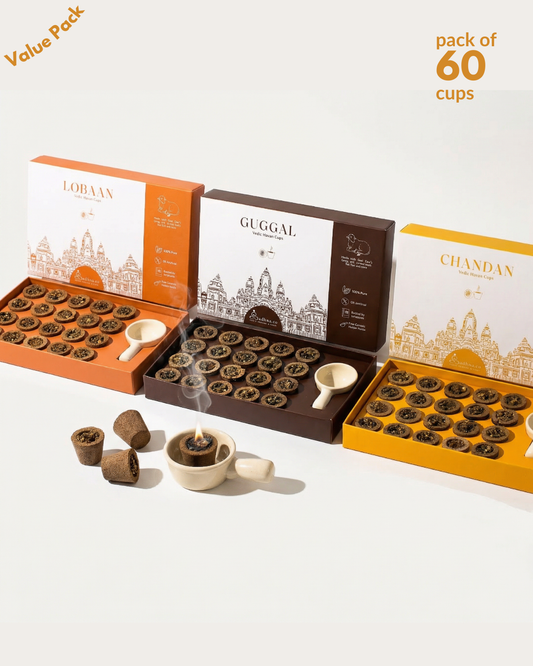
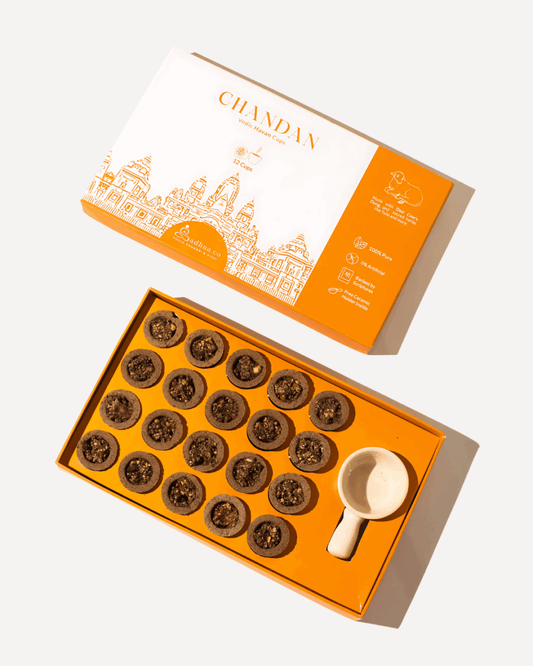
Sadhna.co's Guggul Havan Cup is designed for home havan use — a self-contained cup format that doesn't require an elaborate fire setup. The Guggul resin blend is pressed into the cup with the traditional havan samagri ingredients, and the cup itself acts as the havan kund. For apartment dwellers or households without a dedicated outdoor havan space, this is the practical format. See our complete havan guide for the full ritual vidhi.
How to Use Guggul Dhoop Agarbatti in Daily Practice
The Classic Guggul Dhoop Agarbatti is the incense form — appropriate for daily puja, room purification, and meditation sessions where a full havan isn't practical.
For daily puja: Guggul is appropriate as an offering for Shiva, Vishnu, and most forms of Devi worship. It is specifically mentioned in texts on Shiva puja as a welcome offering. Its deep, slightly medicinal fragrance is better suited to morning or midday worship than to evening or night — it's activating rather than settling.
For space purification: The Ayurvedic dhupana tradition uses Guggul smoke specifically for clearing spaces after illness, conflict, or stagnation. Unlike incense whose primary purpose is fragrance, Guggul dhupana is intended as an active cleansing process. Light the dhoop agarbatti and allow the smoke to move through each room before worship, or after someone in the household has been unwell.
For Manipura (Solar Plexus) practice: Among the chakras, Guggul's heating, activating properties align most clearly with Manipura — the energy centre associated with will, action, and metabolic fire. For practices involving Surya Namaskar, core-activating yoga, or any sadhna oriented toward building personal agency, Guggul's stimulating fragrance profile is a genuine fit rather than an arbitrary association.
For meditation: Guggul is not a meditative fragrance in the soft, inward-drawing sense of sandalwood. It keeps the energy moving. Use it for active, engaged meditation — mantra repetition, visualisation practices, trataka — rather than for open-awareness or breath-watching practice where you want the mind to settle.
Guggul vs Other Sadhna.co Fragrances: When to Choose What
| Fragrance | Best For | Energy Quality | Time of Day |
|---|---|---|---|
| Guggul | Havan, space purification, Shiva puja, Manipura practice | Activating, purifying | Morning / midday |
| Camphor | Aarti, quick purification, activation | Sharp, clarifying | Morning |
| Sandalwood | Daily puja, grounding, all deities | Calm, grounding | Anytime |
| Oudh | Shiva, Bhairav, extended sadhna | Deep, heavy | Night |
| Havan Cups | Full havan ritual | Ritual, complete | Morning / occasion |
| Nagchampa | Vishnu, bhakti, meditation | Warm, devotional | Morning / midday |
If your practice involves regular havan or space purification, Guggul is the one fragrance that covers both the ritual and the functional purpose simultaneously.
Frequently Asked Questions
Q: What does Guggul smell like?
Earthy, resinous, and slightly medicinal — with a balsamic depth similar to myrrh (they're from the same plant genus). It's heavier and more complex than sandalwood, and significantly different from floral incense. When burned, it produces a rich, lasting smoke that fills a room. If you've attended a traditional havan or visited a North Indian temple that uses havan, Guggul is the dominant note in that smell.
Q: Is Guggul the same as myrrh?
They're related but distinct. Both come from the Commiphora genus — Guggul is Commiphora wightii, myrrh is Commiphora myrrha. The fragrance profiles are similar — earthy, balsamic — but Guggul has a more medicinal, sharper quality. Myrrh is smoother and slightly sweeter. In ritual context, they're used differently: Guggul in Indian havan and Ayurveda, myrrh in Egyptian and Christian traditions.
Q: Can Guggul dhoop agarbatti be used instead of a full havan?
For daily or weekly practice, yes — it delivers the fragrance and atmospheric quality of Guggul without requiring a fire setup. For significant ritual occasions (griha pravesh, upanayana, Navratri havan), the full fire ritual with our Guggul Havan Cup is the traditional approach. The dhoop agarbatti is the practical daily alternative, not a replacement for the ritual itself on those occasions.
Q: Which deity is Guggul primarily associated with?
Guggul appears in puja texts across traditions — it's mentioned in Shiva puja vidhi specifically, and as a havan ingredient for Vishnu and Devi worship. It doesn't have the strong single-deity association that Tulsi has with Vishnu or Bilva has with Shiva. Think of it as a havan and purification ingredient that works across traditions rather than being deity-specific.
Q: Is the Mahabharata Karna story about Guggul real?
This story — Krishna recommending Guggul to Karna at Draupadi's Swayamvara — circulates widely but doesn't appear in the critical edition of the Mahabharata. The documented Mahabharata reference is Guggul as a havan ingredient in fire ritual descriptions. The Ramayana reference (Hanuman collecting medicinal plants including Guggul from Gandhamadana) is textually verified in Valmiki's Yuddha Kanda.
Q: How is Guggul used in Ayurveda beyond incense?
Guggul is one of the most important herbs in classical Ayurvedic medicine, used primarily in compound formulations for joint health (Triphala Guggul for arthritis), thyroid function, and lipid metabolism. Guggulsterones — the active steroidal compounds — have been studied for cholesterol reduction and anti-inflammatory effects. For these medicinal applications, standardised oral preparations are used, not incense. The incense application is for its antimicrobial, purifying, and atmospheric properties.
Q: What is the best time to burn Guggul incense?
Morning or midday. Guggul is an activating, heating resin — it raises energy rather than settling it. For evening or pre-sleep practice, sandalwood or lavender are better suited. For morning puja, havan practice, or any time you want to energise and purify a space, Guggul is the right choice.
About the Author: Akshita Singh writes for Sadhna.co on Hindu ritual practice, Ayurvedic tradition, and the role of fragrance in devotional life. Sadhna.co is a pooja essentials brand based in Sahibabad, Uttar Pradesh, making bambooless, chemical-free incense sticks, dhoop cones, havan cups, and attar sprays.