Kartik Maas 2026: Significance, Kartik Snaan, Diwali, and How to Worship Vishnu and Lakshmi This Month
By Akshita Singh | Sadhna.co Published: 2026 | Last Updated: 2026
Kartik Maas — the eighth month of the Hindu lunar calendar — is considered the holiest month in the Vaishnava tradition. It typically falls between October and November. In 2026, Kartik Maas runs from approximately 23rd October to 20th November.
It's the month of Diwali. It's when Chaturmas ends and Vishnu wakes from his four-month cosmic rest on Devuthani Ekadashi. It's when the wedding season resumes, when Tulsi Vivah is performed, and when the largest lamp-lighting festival in the world takes place. If you observe only one month of intensified practice in the year, Kartik Maas is the most auspicious candidate in the Vaishnava framework.
This guide covers the major observances of Kartik Maas in practical detail — what each ritual involves, when it falls, and how to observe it at home.
Why Kartik Maas Is Specifically Holy
The theological framework comes from the Skanda Purana's Kartik Mahatmya (the Greatness of Kartik), one of the most extensive texts dedicated to a single month's observance. The Padma Purana and the Bhagavata Purana both contain substantial sections on Kartik's significance.
The core logic: Vishnu is particularly accessible during Kartik. The month begins as he nears the end of his Yoga Nidra (cosmic rest of Chaturmas) and culminates in his awakening on Devuthani Ekadashi. Worship performed during this period — particularly lighting lamps, bathing in sacred water, and performing Vishnu puja — is described in these texts as carrying multiplied merit.
Kartik is also called Damodar Maas — referring to Vishnu's childhood form as Damodar (the one bound with a rope by Yashoda). The Damodarashtaka, an eight-verse prayer to Vishnu in this form, is recited daily during Kartik in Vaishnava households.
The Major Observances of Kartik Maas
1. Kartik Snaan (The Pre-Dawn Bath)
Kartik Snaan is the practice of bathing before sunrise every day of the month — ideally in a sacred river, but at home with a small amount of Ganga Jal added to the water.
The bath is taken in brahma muhurta — the period roughly 90 minutes before sunrise — which is considered the most spiritually potent time of day. The water is cold. That's part of the point. The austerity of waking before dawn and bathing in cold water is itself the practice — it trains the body and mind for the regularity that serious sadhana requires.
After bathing, the immediate next act is lighting a lamp before Vishnu or Tulsi plant and reciting a brief prayer. In households that observe Kartik Snaan properly, the Tulsi plant receives a lamp every morning and evening throughout the month.
The Kartik Mahatmya states that one Kartik Snaan equals the merit of a thousand ordinary baths, and that one lamp offered to Vishnu during Kartik equals the merit of ten thousand lamps at other times. The texts are making a point about the spiritual leverage of this specific month, not creating a transaction log.
2. Diwali (Kartik Amavasya — New Moon)
Diwali is the most prominent festival within Kartik Maas, falling on the new moon day. In 2026, Diwali falls on 20th October (note: this falls just before Kartik Maas begins in some calculations — the festival is on the Kartik Amavasya, the junction point).
The five-day festival includes:
- Dhanteras (two days before Diwali) — worship of Dhanvantari and Lakshmi, purchase of gold or silver
- Chhoti Diwali / Narak Chaturdashi — the day before Diwali proper
- Diwali (Kartik Amavasya) — Lakshmi puja, lighting of lamps, fireworks
- Govardhan Puja — the day after Diwali
- Bhai Dooj — two days after Diwali
The Lakshmi puja on Diwali is the central religious act of the five days. It's performed in the evening, in the pradosh kala (just after sunset). The standard sequence: clean the puja space thoroughly, draw rangoli at the entrance, place diyas at the doorway and throughout the home, perform Lakshmi puja with sandalwood paste, flowers, sweets, and incense, and recite Lakshmi Ashtakshara Stotram or Sri Sukta.
For Diwali Lakshmi puja fragrance, Lotus, Rose, and Kesar Chandan are the most traditional. Lakshmi is associated with lotus and the fragrance of spring flowers. Our Kesar Chandan Bambooless Incense Sticks and Rose Incense Sticks are both appropriate for Diwali puja.
3. Devuthani Ekadashi (Kartik Shukla Ekadashi)
The most important single day of Kartik Maas. This is when Vishnu awakens from Chaturmas — the four-month cosmic rest. Weddings and auspicious events resume from the following day. Tulsi Vivah is performed on this day or Dwadashi.
We have a complete guide dedicated to this day: Devuthani Ekadashi 2026 (update the date as 2026 specifics are confirmed).
In brief for Kartik Maas context: on Devuthani Ekadashi, perform the standard Ekadashi fast, do extended Vishnu Sahasranama recitation, perform Tulsi Vivah in the evening, and observe the night vigil if possible.
4. Tulsi Vivah
The ceremonial marriage of the Tulsi plant to Vishnu (in the form of Shaligram stone) is one of Kartik Maas's most distinctive rituals. It's performed on Devuthani Ekadashi or Kartik Dwadashi.
Throughout Kartik Maas, the Tulsi plant receives daily lamps — morning and evening. On Tulsi Vivah, the plant is dressed as a bride with a red border cloth, the Shaligram is placed beside it, a small mandap (wedding canopy) is constructed with sugarcane and marigold, and the wedding rituals are conducted.
For Vaishnava households, Tulsi Vivah marks the official start of the wedding season. Daughters of the household who perform Tulsi Vivah are considered to receive the blessings of a good marriage.
5. Kartik Purnima (Dev Diwali)
The full moon of Kartik — called Dev Diwali (Festival of the Gods) — is the closing observance of the month. It falls four days after Devuthani Ekadashi.
In Varanasi, Dev Diwali is the most spectacular night of the year. All the ghats are lit with hundreds of thousands of lamps — a sight that draws pilgrims from across the country. The lamps are offered to the Ganga and to the divine in an observance described in the Skanda Purana as equivalent to the greatest acts of charity.
For home practice: light as many diyas as possible — on the roof, at the entrance, around the Tulsi plant, at windows — and offer them to Vishnu and the river (or symbolically to water). Perform a complete Vishnu puja with full sixteen offerings.
Lakshmi Puja: What to Offer and How
Lakshmi worship during Kartik Maas — and especially at Diwali — follows a clear traditional protocol:
The space: Clean the puja room thoroughly. Lakshmi is said to enter through a clean, fragrant, lamp-lit entrance. Leaving clutter at the entrance or a dark, unclean puja space is the most common way people inadvertently work against what they're trying to invoke.
Fragrance: Lakshmi is associated with lotus, rose, jasmine, and soft florals. For Diwali and Kartik Lakshmi puja:
- Our Rose Bambooless Incense Sticks — rose is the closest common fragrance to lotus in the Indian fragrance tradition
- Our Kesar Chandan — the saffron-sandalwood combination is warm and devotionally rich, appropriate for Diwali's festive energy
- Our Chandan Attar Spray — for fragrancing the entrance and puja space before the ritual, without burning anything in the approach area
Lamp: A diya with pure cow ghee. This is non-negotiable for Diwali Lakshmi puja — ghee lamp is the traditional requirement. Light it before beginning and ensure it stays lit through the puja.
Offerings: Red flowers (lotus if available, hibiscus otherwise), rice grains, sweets (kheer or any white sweet is traditional), and a coconut.
Mantra: Sri Sukta (from the Rigveda — this is the authentic Lakshmi hymn, unlike many verses attributed to the Puranas) is the primary text for Lakshmi worship. The shorter Lakshmi Ashtakshara Stotram is manageable for home practice.
Deep Daan (Lamp Offering): Placing lit diyas at the entrance, in the tulsi plant, at the gate, and at crossroads near the home during Kartik is specifically prescribed in the Kartik Mahatmya as one of the most potent acts of the month. Each lamp offered to Vishnu or at a sacred location during Kartik carries multiplied merit according to the texts.
Sambrani / Havan for Kartik Maas
Purification of the home during Kartik Maas — particularly before Diwali and on Devuthani Ekadashi — is done through both physical cleaning and ritual smoke purification.
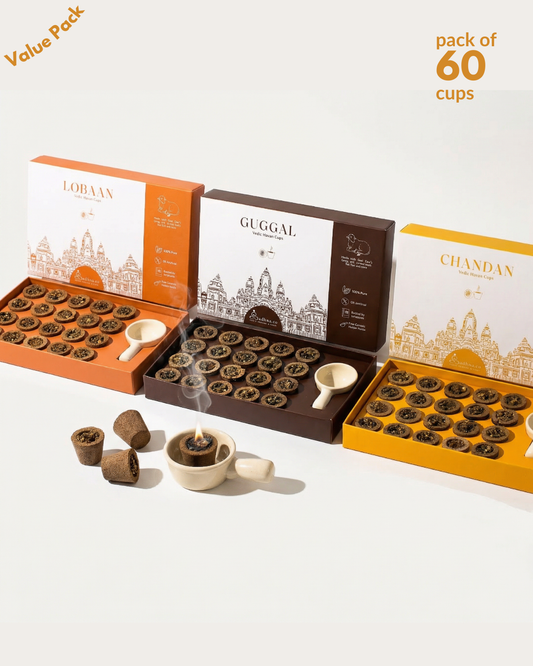
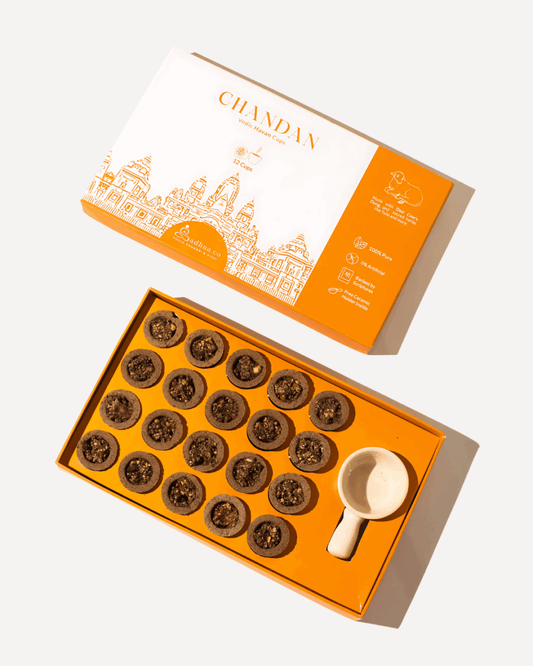
Our Organic Havan Cups are made from cow dung and natural herbs, charcoal-free. For indoor use during Kartik Maas, they produce significantly less smoke than charcoal-based alternatives while maintaining the purifying properties. One cup for the main puja room before Diwali puja cleanses the space both practically (the antimicrobial properties of the herbal smoke) and ritually.
For the Dhoop offering during puja — the slow-burning fragrance that sustains through a longer ritual — our Dhoop Cones burn for 45–60 minutes. For Diwali puja that runs 45 minutes or more, a cone sustains the fragrance where a stick would burn out.
A Kartik Maas Daily Practice Routine
For those wanting to observe the full month seriously:
Every morning: Wake in brahma muhurta. Bathe. Light a diya before Vishnu/Tulsi. Recite Damodarashtaka or one mala of Om Namo Bhagavate Vasudevaya. Light one incense stick.
Every evening: Light a diya before Tulsi at dusk. If possible, do a brief evening puja with lamp and incense.
Ekadashi days (two during Kartik): Full Ekadashi fast. Extended Vishnu Sahasranama. Night lamp vigil.
Diwali: Thorough home cleaning in the afternoon. Full Lakshmi puja in the evening with diyas, incense, flowers, sweets.
Devuthani Ekadashi: Ekadashi fast. Tulsi Vivah in the evening. Night vigil.
Kartik Purnima: Maximum lamp offering. Full Vishnu puja.
Frequently Asked Questions
Q: What is Kartik Maas in 2026?
Kartik Maas 2026 runs approximately from 23rd October to 20th November. The exact dates shift annually with the lunar calendar — check a current Hindu panchang for the precise tithi boundaries.
Q: Why is Kartik Maas called Damodar Maas?
Damodar is a name for Vishnu in his childhood form as Krishna, tied by his mother Yashoda with a rope (dama = rope, udara = belly). During Kartik, the Damodarashtaka — an eight-verse prayer specifically to this form — is recited daily. The name reflects Vishnu's accessibility and the devotional intimacy of this month.
Q: What is the correct time for Kartik Snaan?
Brahma muhurta — roughly 90 minutes before sunrise. The exact timing shifts daily with the season; during Kartik (October-November in India), this is approximately 5:00-5:30 AM depending on location. The bath should be completed before sunrise.
Q: What fragrance does Goddess Lakshmi prefer?
The texts describe Lakshmi as pleased by the fragrance of lotus, rose, jasmine, and soft florals. Sandalwood paste applied to her idol is also traditional across all Lakshmi temple protocols. Avoid heavier fragrances like Oudh for Lakshmi puja — those are more associated with Shaiva worship.
Q: Is Tulsi Vivah compulsory during Kartik?
Tulsi Vivah is strongly recommended but not universal across all Hindu traditions. In Vaishnava households, particularly in Maharashtra, Gujarat, and North India, it's a central Kartik observance. In some Shaiva traditions and in South India, the practice is less prominent. If your family tradition observes it, perform it on Devuthani Ekadashi or Dwadashi.
Q: What is the difference between Diwali and Dev Diwali?
Diwali (Kartik Amavasya) is the new moon festival — the main lamp-lighting and Lakshmi puja occasion. Dev Diwali (Kartik Purnima) is the full moon festival four days after Devuthani Ekadashi — a separate occasion associated specifically with the gods celebrating the end of Chaturmas. Both involve lamp lighting but have different ritual structures and significances.
About the Author: Akshita Singh writes for Sadhna.co on Hindu ritual practice and festival observances. Sadhna.co is a pooja brand based in Sahibabad, Uttar Pradesh, making bambooless, chemical-free incense sticks, dhoop cones, havan cups, and attar sprays for daily and special rituals.